
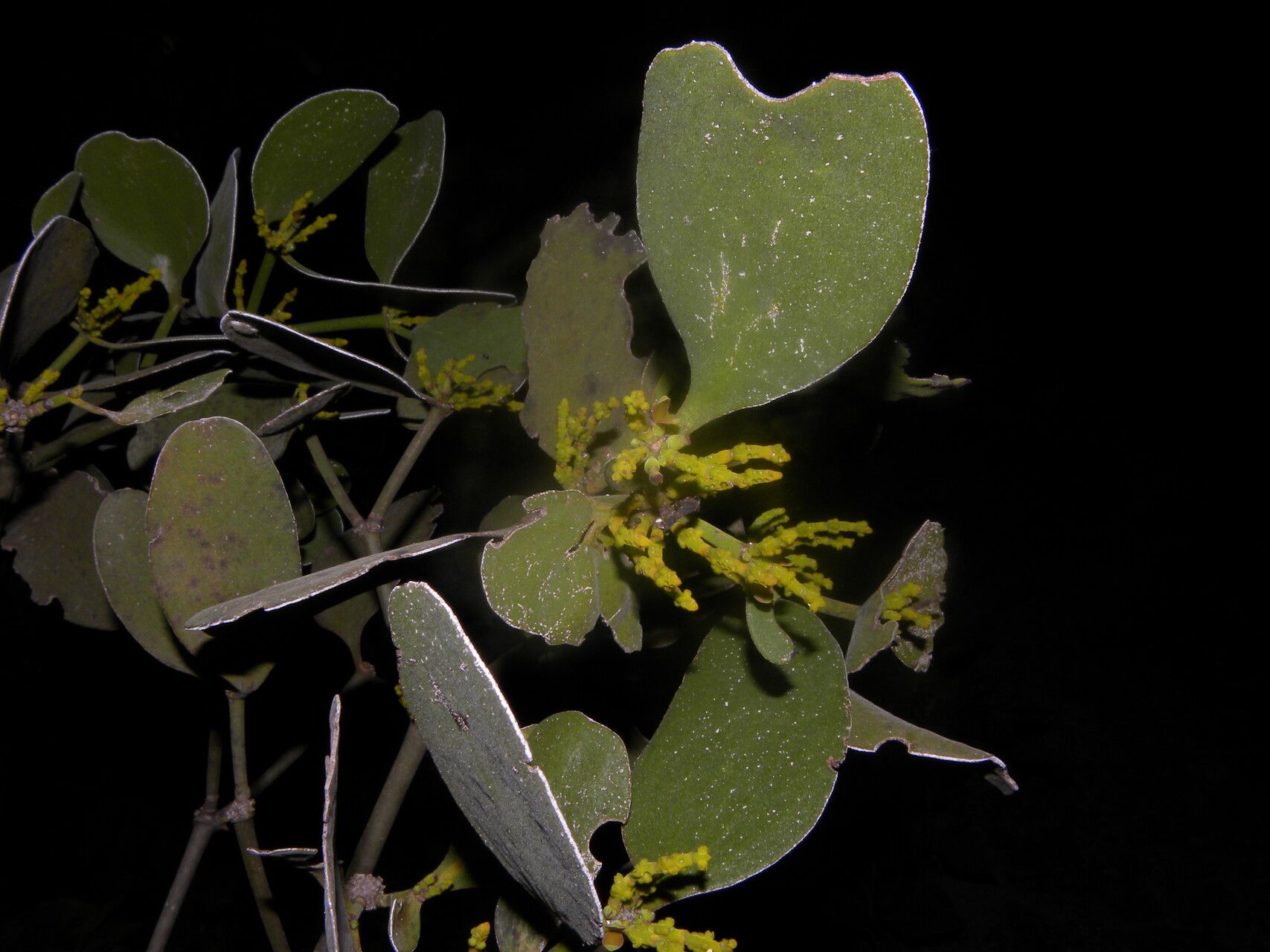
Kissing Under the Mistletoe? How Phoradendron Robustissimum Spreads Holiday Cheer (and More!)
The holidays bring to mind many traditions: cozy fires, twinkling lights, and of course, that sprig of mistletoe hanging overhead, promising a bit of romantic mischief. But did you know that the mistletoe we associate with holiday cheer isn’t the only kind out there? Enter Phoradendron robustissimum, a fascinating plant with a unique story of propagation.
While not the species typically found adorning doorways in December, Phoradendron robustissimum, also known as leafy mistletoe or bigfruit mistletoe, is a fascinating example of the intricate relationships found in the natural world. Like all mistletoes, it’s a hemiparasite, meaning it relies on a host tree for some of its nutrients while also being able to photosynthesize on its own. Found clinging to the branches of hardwood trees in the southeastern United States and parts of Latin America, Phoradendron robustissimum relies on an unlikely partner for its propagation: birds.
It all starts with the plant’s small, sticky berries. These berries, often a vibrant white or pink, are irresistible to certain bird species, especially euphonias and silky-flycatchers. As the birds feast, the mistletoe seeds within the berries pass through their digestive tracts. Here’s where things get interesting! The seeds are coated in a sticky substance called viscin. When a bird excretes the seed, the viscin helps it adhere to the bark of a suitable host tree.
But that’s not all! The viscin also contains a germination inhibitor that is slowly broken down by sunlight. This clever adaptation ensures that the seed won’t germinate inside the bird’s gut or immediately upon excretion. It needs to be exposed to light on the branch of a host tree to have the best chance of survival.
Once the seed germinates, it sends out a specialized root-like structure called a haustorium. This haustorium penetrates the bark of the host tree, tapping into its vascular system to obtain water and nutrients. While Phoradendron robustissimum can photosynthesize, it supplements its energy production by drawing resources from its host.
The relationship between bird, mistletoe, and host tree is a fascinating example of co-evolution. The birds get a nutritious meal, the mistletoe gets dispersed to new locations with ideal growing conditions, and the host tree… well, it tolerates the situation, as the mistletoe rarely causes significant harm.
So, next time you see a sprig of mistletoe, remember that it represents more than just a chance for a holiday kiss. It’s a testament to the intricate and often surprising ways that plants spread and thrive in the natural world. It’s a story of partnership, adaptation, and the fascinating web of life that connects us all.