
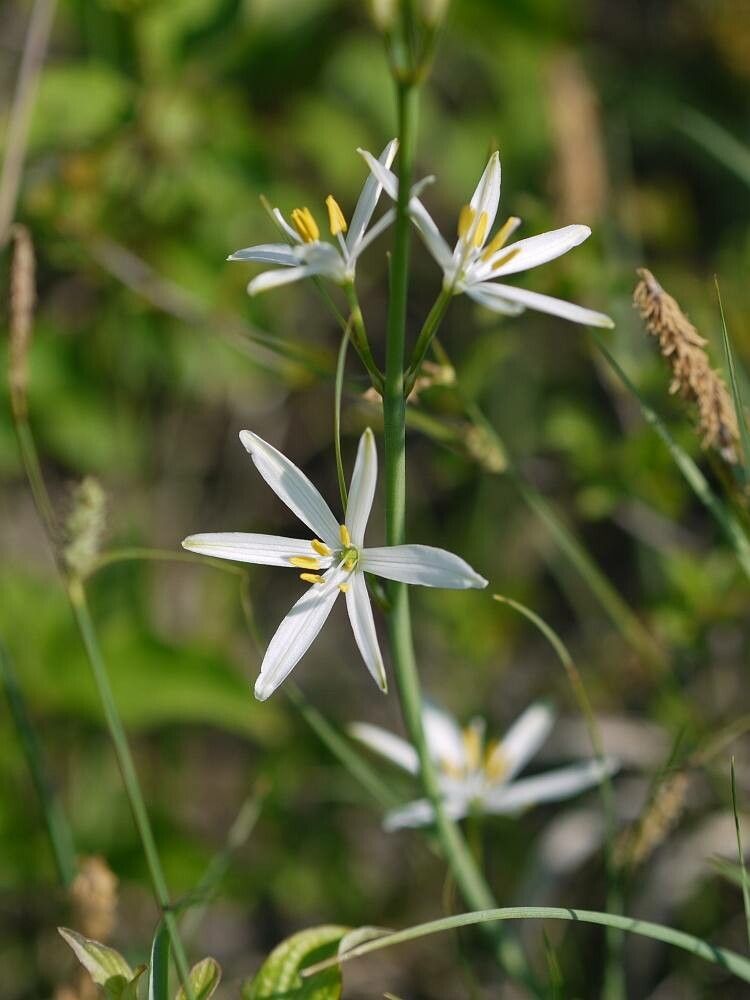
Propagating Anthericum liliago: The Saint Bruno’s Lily
Introduction:
Anthericum liliago, commonly known as Saint Bruno’s Lily, is a charming perennial boasting elegant, white, star-shaped flowers atop slender stems. Its delicate beauty and relatively low-maintenance nature have made it a popular choice among gardeners seeking to add a touch of refined elegance to their borders or rock gardens. However, its propagation can present certain challenges, making success all the more rewarding. This article explores various methods of propagating Saint Bruno’s Lily, highlighting their feasibility and offering practical advice.
Seed Germination:
Currently, there are no known reliable methods for seed germination propagation of Anthericum liliago. While the plant does produce seeds, germination rates are notoriously low, and the process is often unpredictable. The seeds are quite fine and require specific environmental conditions which are difficult to replicate consistently. For these reasons, seed propagation is generally not recommended for this species.
Cuttings:
Cuttings are also generally unsuccessful for propagating Anthericum liliago. The plant does not readily root from stem or leaf cuttings. Attempts at propagation using this method often result in rot before root development occurs. Therefore, cuttings are not a practical or recommended propagation method.
Division:
Division is the most reliable and commonly used method for propagating Saint Bruno’s Lily. This involves carefully separating established clumps of the plant into smaller sections, each containing roots and sufficient foliage.
Challenges: The main challenge lies in ensuring each division has a healthy root system to support its growth. Overly aggressive division can weaken the parent plant and the resulting offshoots.
Practical Tips: The best time for division is in spring or autumn, after flowering or before new growth emerges. Use a sharp, sterile knife or spade to divide the clump, aiming for sections containing at least three or four healthy growths. Plant the divisions immediately in well-draining soil, ensuring they are not planted too deeply. Water gently after planting.
Rewards: Division offers a quick and efficient method for increasing your stock of Saint Bruno’s Lily, resulting in multiple plants identical to the parent. It is relatively straightforward and less technically demanding than other methods.
Tissue Culture:
Tissue culture is a more complex method requiring specialized equipment and expertise. While theoretically possible, it is not a commonly utilized approach for propagating Saint Bruno’s Lily due to the relative ease and higher success rate associated with division.
Challenges: Establishment of sterile conditions, selection of appropriate media and growth regulators, and maintaining aseptic conditions throughout the process are significant challenges. This method is time-consuming and expensive.
Practical Tips: Specialised knowledge and laboratory facilities are essential for conducting successful tissue culture propagation. It requires a significant investment in equipment and materials.
Rewards: Large-scale propagation of genetically identical plants is possible, ensuring uniformity and facilitating commercial applications.
Conclusion:
Propagating Anthericum liliago presents certain challenges, with division emerging as the most accessible and reliable method for most home gardeners. While seed germination and cuttings prove largely unsuccessful, and tissue culture being highly specialized, the relatively straightforward nature of division provides a satisfying and achievable way to multiply these beautiful plants. The unique satisfaction in successfully cultivating this plant from a division lies precisely in overcoming the initial hurdle of correctly separating the rhizome and nurturing the resulting plants to maturity. Don’t be discouraged if your first attempts face setbacks. Patience, careful attention to detail, and the right timing will ultimately reward you with the joy of extending the graceful presence of Saint Bruno’s Lily in your garden.