
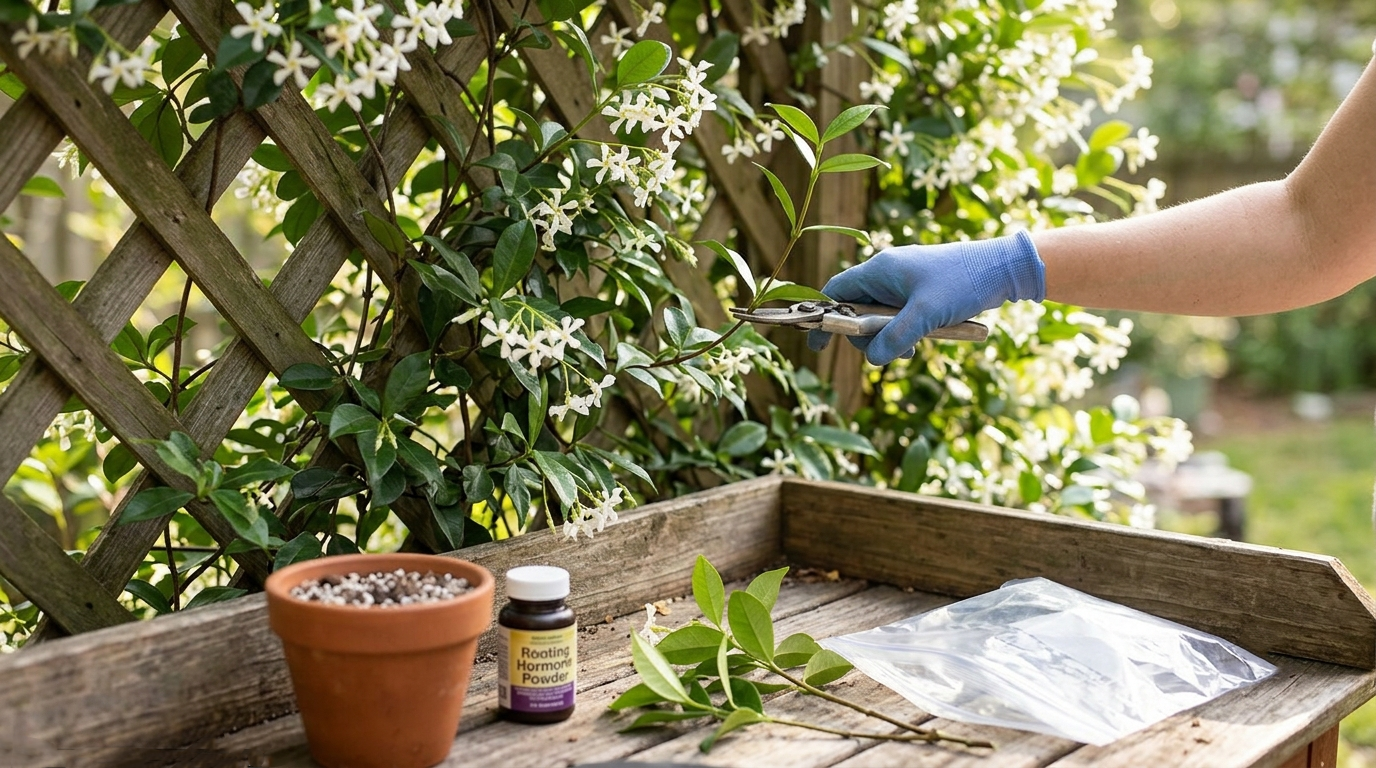
If you’ve ever walked past a fence covered in confederate jasmine on a warm evening, you know exactly why people want more of this plant. That sweet, heady fragrance is the whole reason I planted one beside my back porch — and the reason I started rooting cuttings from it a few summers ago. The good news: confederate jasmine (also sold as star jasmine — both names refer to Trachelospermum jasminoides) is one of the more forgiving woody vines to propagate at home, and midsummer is exactly the right time to try.
When to take cuttings
Summer is the season for this one. From late spring through July, the vine is producing what gardeners call semi-hardwood growth: stems from this year that have started to firm up but still bend without snapping. That’s the sweet spot — soft new tips tend to wilt and collapse, while old woody stems are slow and stubborn to root. One grower who has propagated star jasmine commercially reports that thin, trailing stems root at better than 80 percent, while thicker stems drop to around 50, so pick the skinny, flexible runners rather than the thick main stems.
One quick warning before you start snipping: the cut stems bleed a milky white sap that can irritate skin, so I wear thin gloves for this job.
What you’ll need
- Clean, sharp pruners or snips
- Small pots with drainage holes (non-negotiable — more on that below)
- A free-draining mix: potting soil cut with a few handfuls of grit or perlite, or roughly 90 percent perlite with a little peat
- Rooting hormone powder
- A clear plastic bag, bottle cloche, or propagation box for humidity
- Thin gloves, because of the milky sap
Step by step
- Choose thin, trailing semi-hardwood stems and cut 4- to 6-inch tips, snipping just below a leaf node. Each node you bury is a potential root point.
- Strip off the lower leaves, leaving just one or two small leaves at the top of each cutting.
- Dip the bottom inch of the stem in rooting hormone powder, making sure some lands on that bumpy leaf node.
- Plant the cuttings deep — I leave only about two inches showing above the mix. Five or six cuttings can share one pot.
- Water once, gently, so the mix is moist but not soggy.
- Cover with your bag or propagation box and set the pot somewhere bright but shaded — no direct sun.
- Check every few days and water only when the surface has dried out.
The biggest mistake: loving them to death with water
Almost every failed jasmine cutting I’ve seen — including my own early attempts — died the same way: rot. A cutting with no roots can’t drink much, so a permanently wet mix just softens and blackens the stem before roots ever form. Use pots with drainage holes, use a gritty mix, and let the surface dry between waterings. The humidity cover keeps the leaves happy; the soil itself should stay only barely moist. If a cutting turns black at the base, pull it — it won’t recover, and it’s better to give the others room.
Water or soil?
You can root confederate jasmine in a glass of water on the windowsill, and it’s fun to watch. But water-grown roots are brittle and adapted to water, so cuttings often sulk or fail when they’re moved into soil. Rooting directly in a gritty mix or perlite produces tougher roots and skips that transplant shock, which is why I stick with soil for this plant.
How long it takes, and aftercare
Be patient — this is a vine that takes its time. Roots typically begin forming after two to four weeks, and by six to eight weeks you may spot white roots peeking from the drainage holes. Getting from there to a properly established young plant can take a few months, and cuttings struck late in the year may need three to four months. Once a cutting is clearly growing, wean it off the humidity cover gradually over about a week, then pot it up on its own. In colder areas, I’d overwinter young plants somewhere sheltered and plant them out in spring.
Frequently asked questions
Is confederate jasmine the same as star jasmine?
Yes — both are common names for Trachelospermum jasminoides. Confusingly, it isn’t a true jasmine at all, but the propagation method here works regardless of what your garden center calls it.
Can I propagate confederate jasmine in water?
You can, but roots grown in water tend to be weaker and struggle with the move to soil. Rooting directly in a gritty mix gives you sturdier plants.
How long do star jasmine cuttings take to root?
Roots start forming in about two to four weeks, show at the drainage holes around six to eight weeks, and a cutting may need a few months to become a plantable young vine.
Do I need rooting hormone for jasmine cuttings?
It isn’t strictly required, but on woody vines like this it noticeably improves your odds, and it’s inexpensive. I use it every time.
Why are my jasmine cuttings turning black?
That’s almost always rot from a mix that stays too wet. Improve the drainage, water less, and take fresh cuttings from thin, semi-hardwood stems.
Related guides
- How to propagate lavender from cuttings — the same semi-hardwood technique on a smaller scale
- Boxwood cuttings: the easiest way to grow your own — another woody evergreen that roots the same way
- DIY propagation box — the humidity setup I use for cuttings like these
— Nora Ellison