
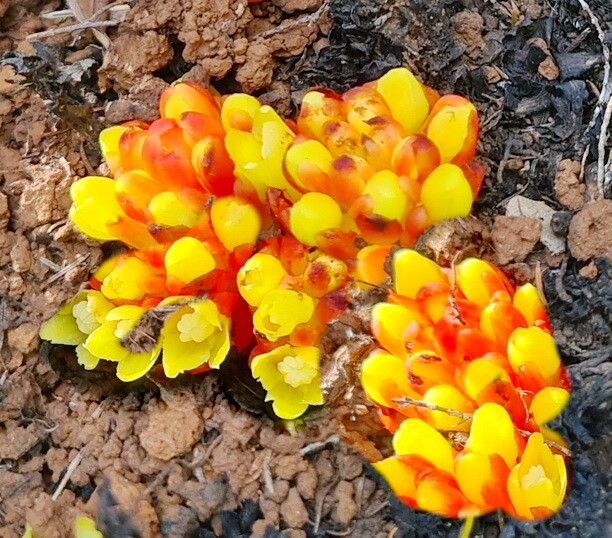
The Underground Hitchhiker: Unraveling the Mysterious Propagation of Cytinus hypocistis
The plant kingdom never fails to amaze, often employing strategies that seem ripped from a science fiction novel. Take for instance Cytinus hypocistis, a plant so unusual that even seasoned botanists can’t help but be intrigued. This fascinating species has abandoned photosynthesis, choosing instead a life of parasitic dependence, and its propagation methods are just as peculiar as its lifestyle.
Cytinus hypocistis, sometimes called the “rock rose parasite”, is found primarily around the Mediterranean basin. Lacking chlorophyll entirely, this plant presents a striking visual contrast: vibrant red to yellow flowering shoots emerging directly from the ground, seemingly out of nowhere. This dramatic appearance hints at its secret life below the surface.
The secret, you see, lies in its parasitic nature. Cytinus hypocistis survives by tapping into the roots of specific host plants, particularly those belonging to the Cistaceae family, which includes the beautiful rock roses. The plant’s vegetative body exists entirely underground as a network of specialized structures called haustoria. These haustoria act like biological pipelines, drawing nutrients directly from the unsuspecting host plant.
But the intrigue doesn’t stop there. Unlike most plants that rely on wind or pollinators, Cytinus hypocistis has opted for a more clandestine method of propagation: ants. Yes, you read that right. The flowers of this peculiar plant produce a nectar-like substance highly appealing to ants. These unwitting accomplices, attracted by the sweet reward, crawl into the flowers and inadvertently collect pollen on their bodies. As they move from flower to flower, they act as unwitting pollinators, facilitating the fertilization process.
Once fertilization occurs, Cytinus hypocistis develops fleshy berries filled with numerous tiny seeds. These seeds are then dispersed by a process known as myrmecochory – again, with the help of ants. The ants, attracted by a special structure on the seed called an elaiosome, carry the seeds back to their nests, often some distance away from the parent plant.
While this may seem like an overly elaborate scheme, it’s a brilliant adaptation for a plant that spends its life underground. Utilizing ants as both pollinators and seed dispersers allows Cytinus hypocistis to overcome its immobility and thrive in its unique ecological niche.
This complex yet efficient propagation strategy ensures the continuation of this fascinating species. Studying Cytinus hypocistis not only sheds light on the incredible diversity of plant life but also offers valuable insights into the intricate relationships that exist within ecosystems. It serves as a compelling reminder that the natural world is full of surprises, waiting to be discovered and understood.