
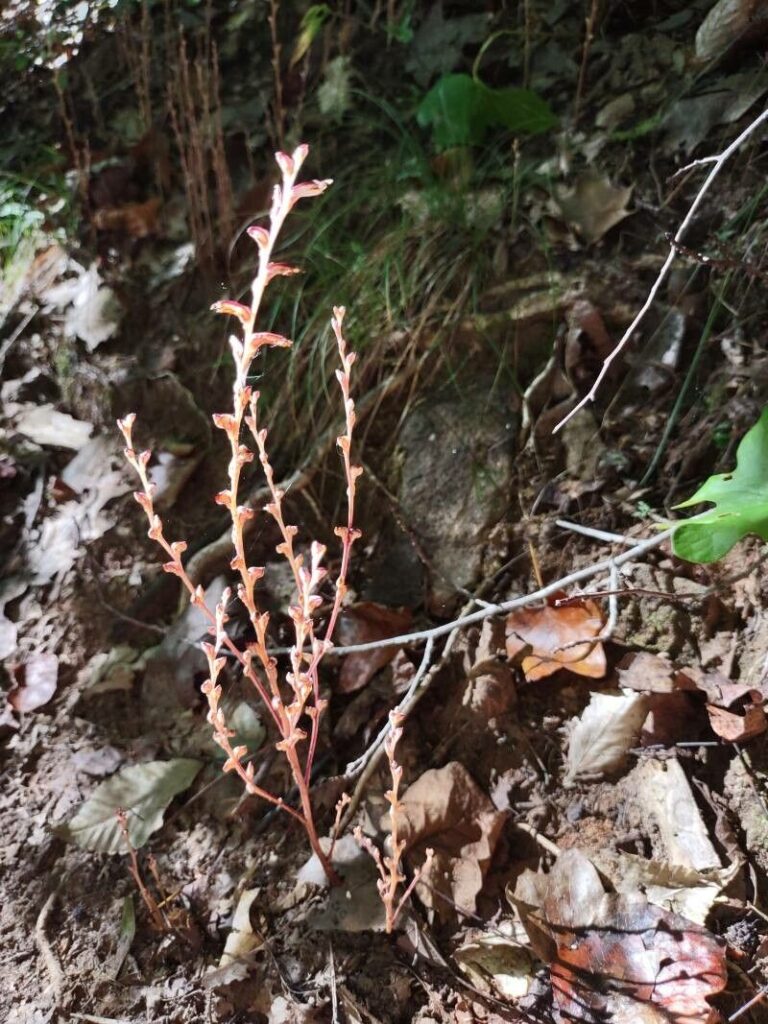
The Ghost Plant’s Secret: Unraveling the Unusual Propagation of Epifagus virginiana
Have you ever heard of a plant that lacks chlorophyll? One so elusive it’s often called the “ghost plant?” Enter Epifagus virginiana, more commonly known as beechdrops. This fascinating plant, devoid of green, lives a life shrouded in mystery and reliant entirely on its host, the American beech tree. Today, we’ll delve into the unusual world of Epifagus virginiana and explore its unique propagation methods.
A Life Less Green: Understanding Beechdrops
Unlike most plants that obtain energy through photosynthesis, Epifagus virginiana lacks chlorophyll, the pigment responsible for capturing sunlight. Instead, it survives as an obligate parasite, completely dependent on the roots of American beech trees (Fagus grandifolia) for its sustenance. This parasitic relationship dictates its life cycle and, ultimately, its propagation.
Hidden in Plain Sight: The Underground Network
While the above-ground appearance of beechdrops might seem ephemeral, the real magic happens below the surface. Epifagus virginiana connects to its host through a specialized structure called a haustorium. This haustorium penetrates the beech’s roots, tapping into the tree’s vascular system and siphoning off water and nutrients.
A Fleeting Beauty: Flowering and Seed Production
For a brief period in late summer to fall, beechdrops emerge from the ground, showcasing their eerie beauty. They produce small, tubular, fleshy flowers ranging in color from white to pale yellow, often with delicate purple stripes. These flowers, though small, hold the key to the plant’s continued survival.
Epifagus virginiana employs a clever tactic called self-pollination. Within each flower, both male and female reproductive organs exist, allowing for fertilization to occur without dependence on external pollinators. Once pollinated, these flowers develop into tiny capsules, each containing numerous dust-like seeds.
The Waiting Game: Seed Dispersal and Germination
As the beechdrops wither and die back, their seed capsules mature and eventually burst open, scattering the minuscule seeds onto the forest floor. Here, the seeds lie dormant, waiting for the perfect conditions to germinate.
And what are these perfect conditions? The presence of a suitable host, of course!
Scientists believe that the seeds are stimulated to germinate by specific chemicals released by the roots of nearby American beech trees. Upon encountering these chemical signals, the seeds spring to life, sending out roots that seek out and connect with the beech’s root system, beginning the cycle anew.
Conservation Considerations
The unique lifecycle of Epifagus virginiana highlights its complete dependence on healthy American beech populations. Unfortunately, beech bark disease, caused by an invasive insect and fungus, poses a significant threat to American beech trees across their range.
Protecting existing beech forests and supporting research on beech bark disease management are crucial steps in ensuring the continued survival of both the American beech and the fascinating, ephemeral Epifagus virginiana.
So, the next time you find yourself walking through a beech forest, keep an eye out for these fascinating “ghost plants.” Their existence reminds us of the intricate and often unseen relationships that make up the web of life in our forests.