
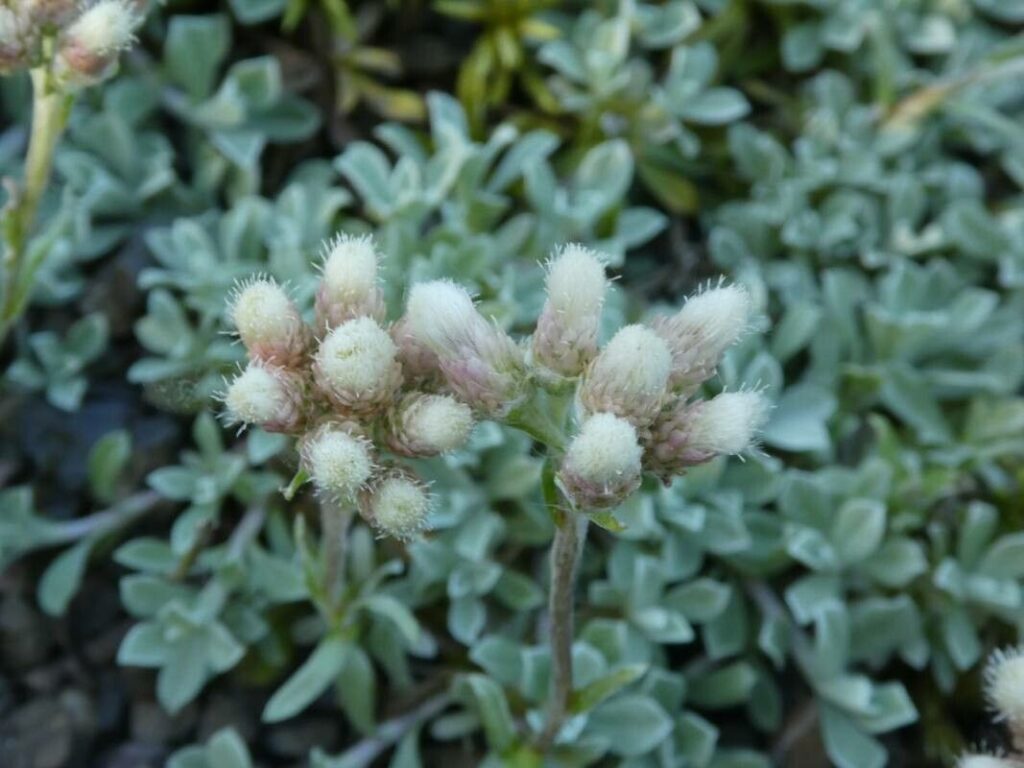
Propagating Antennaria parvifolia: Challenges and Rewards of Cultivating Small-Leafed Pussytoes
Antennaria parvifolia, commonly known as small-leaved pussytoes, is a charming, low-growing perennial belonging to the Asteraceae family. Its fuzzy, silvery-grey foliage and delicate, fluffy white flower heads make it a popular choice among gardeners seeking drought-tolerant, low-maintenance ground cover. Its ability to thrive in poor, rocky soils adds to its appeal for landscaping projects in challenging environments. Propagating this resilient plant, however, presents a unique set of challenges and rewards, as we explore below.
Seed Germination:
Currently, there are no known reliable methods for seed germination propagation of Antennaria parvifolia. While seed production occurs, the germination rate is notoriously low, likely due to various factors including seed dormancy mechanisms and environmental sensitivity. Attempts at stratification (cold treatment) and various sowing techniques have yet to yield consistent success. Therefore, relying on seed germination for propagation of this species is not recommended.
Cuttings:
Propagating Antennaria parvifolia from cuttings presents moderate challenges but offers a more reliable strategy than seed germination. Success hinges on utilizing healthy, actively growing stem cuttings in spring or early summer.
Challenges: Cuttings can be slow to root. The success rate depends greatly on maintaining consistently moist but not waterlogged conditions and providing protection from direct sunlight. Fungal diseases can be a problem if hygiene isn’t maintained.
Practical Tips: Use sharp, sterilized tools to take basal stem cuttings (approx. 4-6 cm long), removing lower leaves before dipping them in rooting hormone. Plant cuttings in a well-draining propagation mix, ideally kept consistently humid under a humidity dome or plastic covering. Gentle bottom heat can hasten root development.
Rewards: Cuttings offer a relatively quick method to increase the number of plants compared to division. This allows for preserving the desirable characteristics of the mother plant, maintaining genetic uniformity.
Division:
Division is arguably the most successful and easiest method for propagating Antennaria parvifolia.
Challenges: The best time to divide is during spring or autumn when the plant is actively growing or breaking dormancy. Divisions must be large enough to contain sufficient roots and growing points for successful establishment. Rough handling can damage the plant, inhibiting the growth of divisions.
Practical Tips: Carefully dig up the established plant, gently separating it into smaller clumps, with each division containing multiple stems and roots. Plant these divisions immediately into prepared soil at the same depth as the original plant. Water thoroughly after planting.
Rewards: Division is a reliable, simple, and relatively quick way to increase the number of plants. It allows the gardener to rejuvenate the mother plant by removing old, crowded portions, ensuring vigorous regrowth.
Tissue Culture:
This method is not commonly employed for Antennaria parvifolia propagation due to its complexity and cost.
Challenges: Establishing sterile conditions and selecting appropriate growth media and hormones for successful tissue culture are highly technical and require specialized knowledge and equipment.
Practical Tips: This is generally not a home propagation method. Specialized labs are needed.
Rewards: Tissue culture allows for rapid clonal propagation on a large scale, maintaining genetic uniformity and disease-free planting material.
Conclusion:
Propagating Antennaria parvifolia presents a spectrum of difficulties and successes. While seed germination is currently not a viable option, cuttings and especially division offer reliable means for increasing the number of plants. The rewards, however, are substantial. The satisfying process of nurturing a cutting to a thriving plant, or watching a division flourish into its own independent clump, provides a unique connection with the natural world and a deep sense of accomplishment. For aspiring propagators, starting with the simpler division method is recommended, building confidence before exploring the more intricate technique of cuttings. Remember patience and careful attention to detail are key ingredients in successfully cultivating the charming small-leaved pussytoes.