
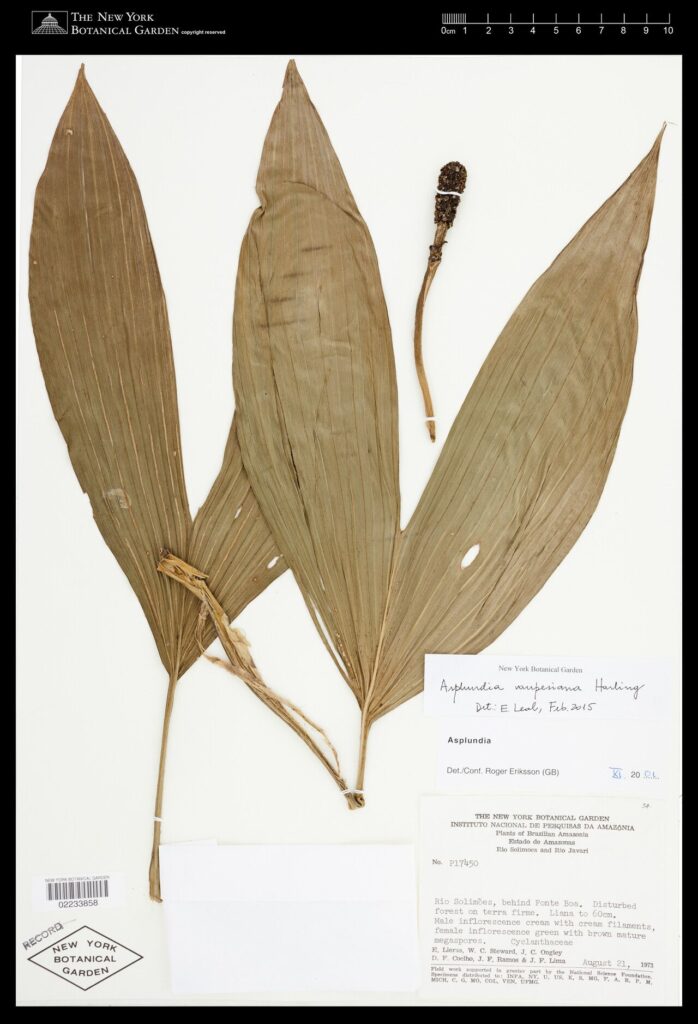
Propagating Asplundia vaupesiana: A Challenging but Rewarding Endeavor
Asplundia vaupesiana, a member of the Cyclanthaceae family, is a relatively unknown but fascinating plant prized by collectors for its unique aesthetic qualities. While it lacks a widely recognized common name, its striking foliage and intriguing growth habit make it a coveted addition to specialized plant collections. Its propagation, however, presents several challenges, making successful cultivation a source of considerable satisfaction.
Seed Germination:
Currently, there are no known reliable methods for seed germination propagation of Asplundia vaupesiana. Limited research is available on this species, and the viability and germination requirements of its seeds remain largely unexplored. Further research into its seed biology is needed to determine if seed propagation is even feasible.
Cuttings:
The success rate of propagating Asplundia vaupesiana from cuttings is also questionable, based on the limited available information. Challenges likely include the difficulty in rooting stems, susceptibility to fungal diseases, and the overall slow growth rate even under ideal conditions.
- Challenges: High risk of rot due to high humidity requirements often necessary for rooting. Slow rooting times.
- Practical Tips (if attempting): Experiments could focus on using a bottom heat mat for consistent warmth and humidity, rooting hormones like auxins, and a well-draining yet moisture-retentive substrate like a mix of perlite and peat moss. Sterilizing cuttings and the propagation medium is crucial to minimizing fungal infections.
- Rewards (if successful): If successful, cuttings offer a relatively faster method of propagation compared to division, but the success rate is expected to be low.
Division:
Division is potentially the most reliable, albeit limited, method for propagating Asplundia vaupesiana. Mature plants may occasionally produce offsets or pups that can be carefully separated.
- Challenges: Limited numbers of offsets per plant. Care is needed to avoid damaging the parent plant and the delicate roots of the offsets during separation. Slow establishment of the divisions.
- Practical Tips: Division should ideally occur during the plant’s active growing period. Use a sharp, sterile knife to separate the offsets, ensuring each division has a healthy root system. Pot the divisions in a well-draining, nutrient-rich substrate and maintain high humidity.
- Rewards: A more reliable method than cuttings, though limited by the infrequent production of offsets. This method preserves the genetic characteristics of the parent plant.
Tissue Culture:
Tissue culture offers the potential for large-scale propagation of Asplundia vaupesiana, bypassing the challenges of seed germination and cuttings. However, this method requires specialized knowledge, equipment, and sterile conditions.
- Challenges: Establishing aseptic conditions, selecting appropriate growth media and hormones, optimizing culture conditions, and preventing contamination. High initial investment in equipment and expertise.
- Practical Tips (if attempting): Consult with experienced tissue culture specialists. Develop aseptic techniques to minimize contamination. Experiment with various media formulations and hormone concentrations to find the optimal conditions for shoot multiplication and root induction.
- Rewards: Potential for mass propagation, rapid multiplication of genetically identical plants, and disease elimination.
Conclusion:
Propagating Asplundia vaupesiana presents significant horticultural challenges across all methods explored. While division offers the most realistic approach for the amateur propagator, the success rate remains limited. Tissue culture offers potential for large-scale propagation but requires significant resources and expertise. The lack of viable seed germination methods restricts the genetic diversity achievable through propagation. Nevertheless, the unique beauty and rarity of this plant make the effort worthwhile. The satisfaction of successfully propagating this challenging species far outweighs the difficulties, offering a sense of accomplishment that is rarely matched. Aspiring propagators should approach this endeavor with patience, persistence, and a focus on mastering aseptic techniques and meticulous care. Even with limited success, the learning experience itself is valuable.