
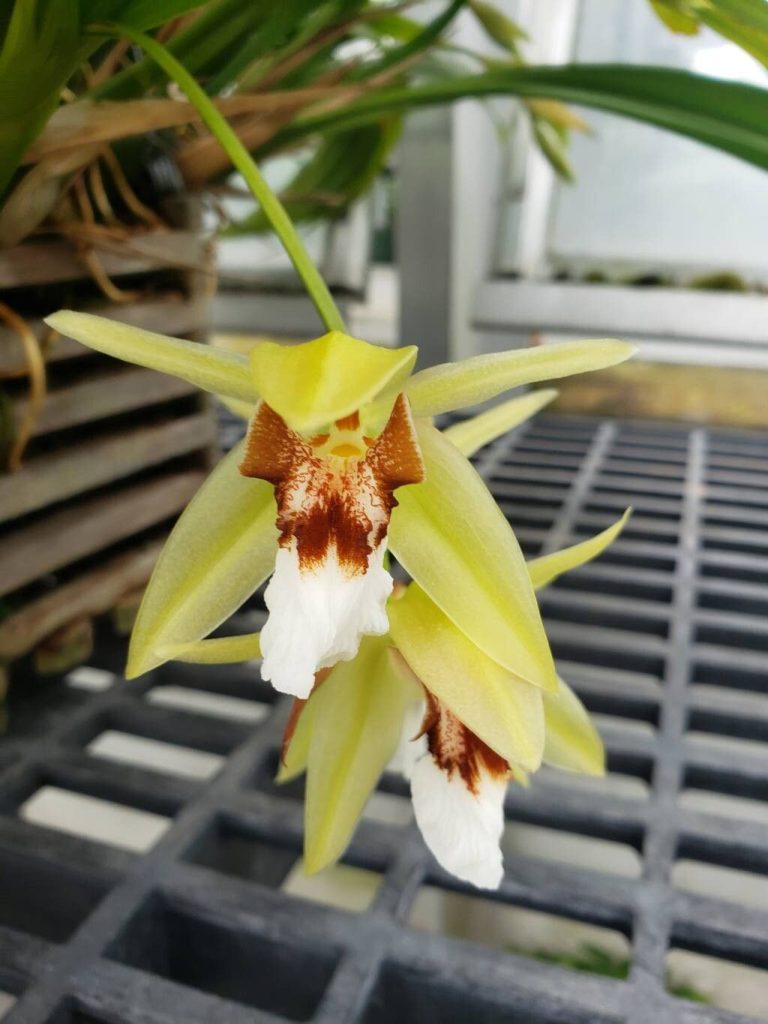
Propagating the Marble Orchid: A Guide to Coelogyne marmorata
Introduction:
Coelogyne marmorata, also known as the Marble Orchid, is a captivating epiphytic orchid prized for its striking foliage and elegant, pendulous flowers. Its leaves exhibit a distinctive marbled pattern of dark green and silver, providing year-round visual interest even outside of its blooming period. This characteristic, coupled with its relatively easy cultivation compared to some other Coelogyne species, contributes to its popularity among orchid enthusiasts. However, propagation can present some unique challenges, making successful cultivation all the more rewarding.
Seed Germination:
Currently, there are no known reliable methods for seed germination propagation of Coelogyne marmorata. Orchid seeds, including those of Coelogyne marmorata, are dust-like and lack endosperm (the food source for germination). They require symbiotic relationships with specific mycorrhizal fungi for successful germination, a relationship difficult to replicate in a home or even professional laboratory setting without specialized knowledge and equipment.
Cuttings:
Propagating Coelogyne marmorata through cuttings is generally not successful. Unlike some other plants, orchids do not readily root from stem or leaf cuttings. The lack of sufficient meristematic tissue (actively dividing cells) prevents the development of new plantlets from these cuttings.
Division:
Division is the most reliable and widely practiced method for propagating Coelogyne marmorata. This involves carefully separating the plant into smaller divisions, each containing multiple pseudobulbs and roots.
- Challenges: The main challenge lies in ensuring each division has a healthy, established root system to support its growth. Dividing the plant too aggressively can severely weaken or even kill the parent plant and the divisions.
- Practical Tips: Divide the plant during or just after its growth period (usually spring). Use a sharp, sterile knife or shears to avoid damaging the rhizomes. Ensure each division has at least three to five pseudobulbs and a good clump of roots. Plant the divisions in a well-draining medium appropriate for epiphytes (e.g., a bark-based mix).
- Rewards: Division offers a relatively straightforward method of increasing the number of plants, preserving the genetic characteristics of the parent plant, and potentially accelerating flowering in the divided plants.
Tissue Culture:
Tissue culture offers a potentially high-yield method for propagating Coelogyne marmorata. This technique involves growing plantlets from small explants (tissue samples) in a sterile, nutrient-rich medium.
- Challenges: Tissue culture requires specialized equipment (e.g., laminar flow hood, autoclave), sterile techniques, and a detailed understanding of orchid physiology and nutrient requirements. It is not a method readily accessible for the home propagator. Contamination can easily wipe out entire cultures.
- Practical Tips: This method is best left to professional orchid labs or specialized nurseries.
- Rewards: Tissue culture enables mass propagation, disease elimination, and the potential for genetic improvement through selection.
Conclusion:
Propagating Coelogyne marmorata presents distinct challenges, with division being the most practical method for the average enthusiast. While seed germination and cuttings are not viable options, tissue culture offers a high-yield, although sophisticated, alternative. The rewards of successful propagation, however, far outweigh the difficulties. Witnessing the elegant marbled foliage and delicate blooms of a plant you’ve nurtured from a division is an immensely satisfying experience that underscores the connection between cultivator and plant. Don’t be discouraged by the initial hurdles; start with division, mastering the technique and gradually gaining confidence. The beauty of the Marble Orchid is worth the effort.