
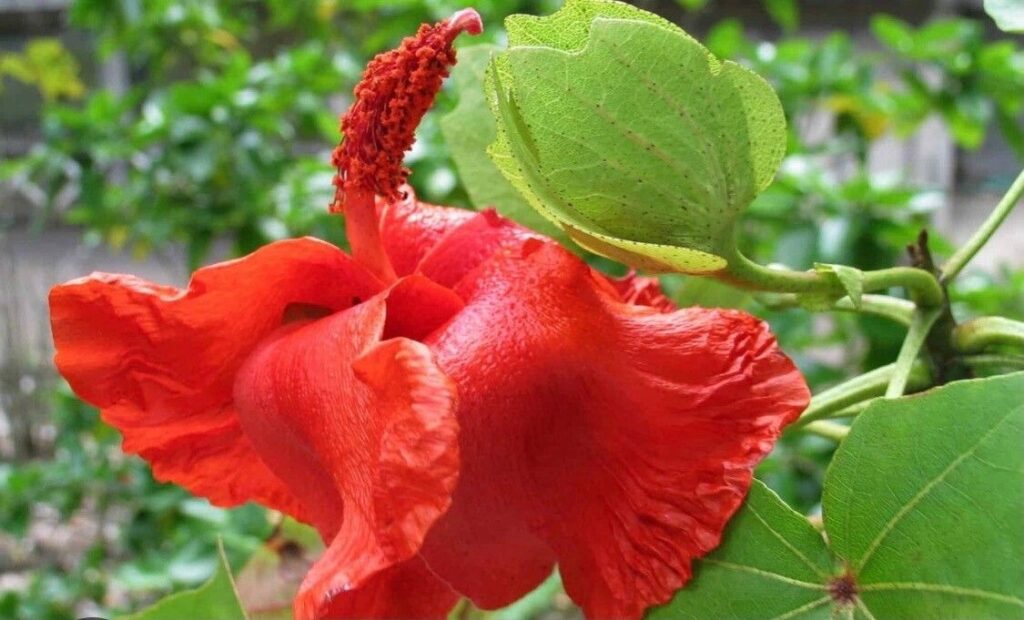
Resurrecting a Ghost: The Delicate Art of Propagating the Kokia cookei
The plant world is full of fascinating stories, but few are as captivating as that of the Kokia cookei, also known as the Molokaʻi treecotton. This Hawaiian endemic, once thought to be extinct, clings to existence by a thread, its survival reliant on the dedication of botanists and the painstaking art of propagation.
The story of the Kokia cookei is one of resilience and fragility. Endemic to the island of Molokaʻi, this small, deciduous tree was known for its vibrant, hibiscus-like flowers that blazed in shades of orange-red, a spectacle that earned it the moniker “Kokiʻo ʻula,” meaning “red kokiʻo” in Hawaiian. Sadly, habitat loss due to grazing animals and competition from invasive species pushed the Kokia cookei to the brink. By the 1950s, only a solitary tree remained in the wild, only to succumb to death’s embrace in 1978.
The extinction of the last known Kokia cookei sent shockwaves through the botanical community. Yet, like a phoenix from the ashes, a glimmer of hope emerged. Prior to the last tree’s demise, cuttings were taken and grafted onto related species, a technique known as grafting propagation. This method involves splicing a cutting from the desired plant (scion) onto a closely related plant with an established root system (rootstock). If successful, the scion heals, draws nutrients from the rootstock, and begins to grow as if it were on its own roots.
While grafting offered a lifeline, the journey to revive the Kokia cookei was far from over. Grafting, though effective, is not a guaranteed solution, particularly with a species as rare and sensitive as the Kokia cookei. Finding compatible rootstocks proved challenging, and even when grafts were successful, the resulting trees often lacked the vigor and longevity of their wild counterparts. Nevertheless, researchers persevered, meticulously nurturing each grafted specimen and studying its growth habits to unlock the secrets of its survival.
Today, thanks to these tireless efforts, a small number of Kokia cookei trees exist in controlled environments. Botanists continue to refine propagation techniques, experimenting with various rootstocks, soil conditions, and microclimates to optimize growth and increase genetic diversity. Seed banking has also become a crucial component of conservation efforts, with researchers cautiously collecting and storing seeds to ensure the long-term preservation of this precious genetic heritage.
The story of the Kokia cookei is a poignant reminder of the fragility of our natural world and the importance of conservation. It highlights the dedication and ingenuity required to bring a species back from the brink and the critical role that propagation plays in preserving biodiversity. While the future of the Kokia cookei remains uncertain, the ongoing efforts to resurrect this magnificent species offer a beacon of hope and a testament to the enduring power of life itself.