
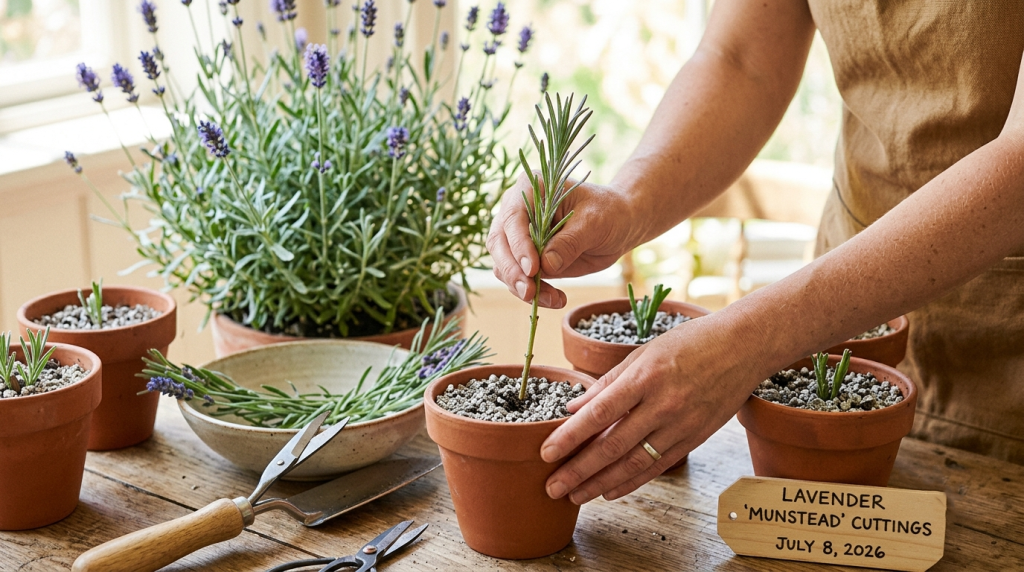
If you have one lavender plant you love, you can have ten — for free — and right now is the moment to do it. I’m writing this in July, which is honestly the sweet spot for taking lavender cuttings: the fresh spring growth has started to firm up but the tips are still green and flexible. That in-between wood roots more reliably than either the soft spring shoots or the woody old stems. I’ve filled a whole border this way from a single plant, and I’ll walk you through exactly how I do it.
When to take lavender cuttings
You have two windows. Softwood cuttings come from the soft, bendy new growth in late spring (roughly May to June) and root fast. Semi-hardwood cuttings come from this year’s growth once it has started to harden at the base but is still green at the tip — late summer, around August into September. July, where I am, straddles the two, and that’s why it’s my favourite time to do it: the cuttings root quickly but they’re firm enough not to flop and rot. Whichever window you’re in, the method below is the same.
What you’ll need
- A healthy lavender plant to take cuttings from
- Clean, sharp snips or scissors
- Small pots or a seed tray with drainage holes
- A free-draining, gritty mix — see below
- Rooting hormone (optional — I’ll be honest about when it helps)
How to take the cutting
Choose a non-flowering shoot. This matters more than anything: a stem that’s busy making flower buds is spending its energy on blooms, not roots. Look for a straight, healthy side shoot with no buds on it.
Cut about four inches (10 cm) of shoot — a little longer, up to six inches, is fine for firmer semi-hardwood stems. Make the cut just below a leaf joint (a node), because that’s where roots form most readily. Then strip the leaves off the bottom two-thirds of the cutting, leaving just a tuft of leaves at the top. Bare stem goes in the pot; leaves stay above the surface.
Step by step
- Mix a gritty, fast-draining medium. A 50/50 blend of perlite and seed compost is my go-to; sand and perlite, or a cactus mix, work just as well. This one choice is the difference between success and a tray of mush — more on that below.
- Dip in rooting hormone (optional). A light dusting on the cut end can speed things up by a few days and nudge your success rate up. Don’t overdo it — too much actually holds rooting back. If you don’t have any, lavender roots perfectly well without it.
- Insert the cutting. Make a hole with a pencil, slide the bare stem in deep enough to stand up on its own, and firm the mix gently around it. You can fit several around the edge of one pot.
- Water once, then go easy. Water it in to settle the mix, let it drain fully, and after that keep it only barely moist. Bright, indirect light and a bit of warmth is all it needs.
The one thing that kills lavender cuttings
Almost every failed lavender cutting dies for the same reason: too much moisture. Lavender evolved on dry, rocky Mediterranean hillsides, and before it has roots to drink with, a wet stem simply rots. So resist the urge to fuss. If you use a humidity dome or a clear bag to stop the leaves drying out, open it for fifteen minutes a day so air can move — sealing it up tight is what breeds fungal rot. Free-draining mix, sparing water, a little airflow. That’s the whole secret.
What about rooting lavender in water?
You’ll see people rooting all sorts of cuttings in a jar on the windowsill, but I’d skip it for lavender. Like its Mediterranean cousins rosemary and thyme, lavender wants a gritty, well-drained medium — the roots it makes in water tend to be weak and rot-prone, and they struggle when you move them to soil. Root it in a gritty mix from the start and you’ll save yourself the disappointment.
How long until it roots?
Softwood cuttings usually root in about two to four weeks; firmer semi-hardwood ones take four to six. You’ll often see fresh growth at the tip as a first sign, and a very gentle tug that meets a little resistance tells you roots have formed. With decent technique you can expect somewhere between a 70% and 90% strike rate — so take a few more than you need and don’t mourn the odd failure.
Aftercare: potting on and the first winter
Once a cutting has a good root system — usually six to eight weeks in, when you see new top growth or roots peeking from the drainage holes — pot it on into its own small pot. Grow it on somewhere bright and sheltered. Young plants can go out into the garden after your last frost, once nights stay reliably above about 50°F (10°C); harden them off over a week or two first by putting them outside for longer each day.
If your cuttings are still small going into autumn, don’t rush them. Little lavenders overwinter happily in their pots in a cold greenhouse, a cold frame, or a sheltered spot by the house, and plant out in spring. This works for all the common types — English, French and Spanish lavender all root the same way, with English being the hardiest if you garden somewhere cold.
Frequently asked questions
Can you grow lavender from a cutting?
Yes — and it’s the best way to get an exact copy of a plant you like. Take a four-inch non-flowering shoot, strip the lower leaves, and root it in a gritty, free-draining mix. Most cuttings root within two to six weeks.
What is the best month to take lavender cuttings?
Late spring through late summer. Softwood cuttings in May–June root fastest; semi-hardwood cuttings in August–September are very reliable. July sits right in the middle and works beautifully.
Do lavender cuttings need rooting hormone?
No, but a light dusting can speed rooting by a few days and lift your success rate a little. Use it sparingly — too much hormone actually inhibits rooting.
Can lavender cuttings root in water?
It’s not recommended. Lavender is a Mediterranean plant that prefers a dry, gritty medium; roots grown in water are weak and prone to rot, and often fail when moved to soil. Root it directly in a free-draining mix instead.
Why do my lavender cuttings keep dying?
Almost always overwatering and a soggy medium. Use a gritty, fast-draining mix, water sparingly, give the cuttings some airflow, and never seal them in a closed dome without venting.
Related guides
- Rosemary Cuttings: Grow Your Own Herb Garden — lavender’s Mediterranean cousin, rooted exactly the same way.
- Boxwood Cuttings: The Easiest Way to Grow Your Own — more semi-hardwood cutting practice.
- Multiplying Roses from Cuttings — take one shrub and make many.
— Nora Ellison