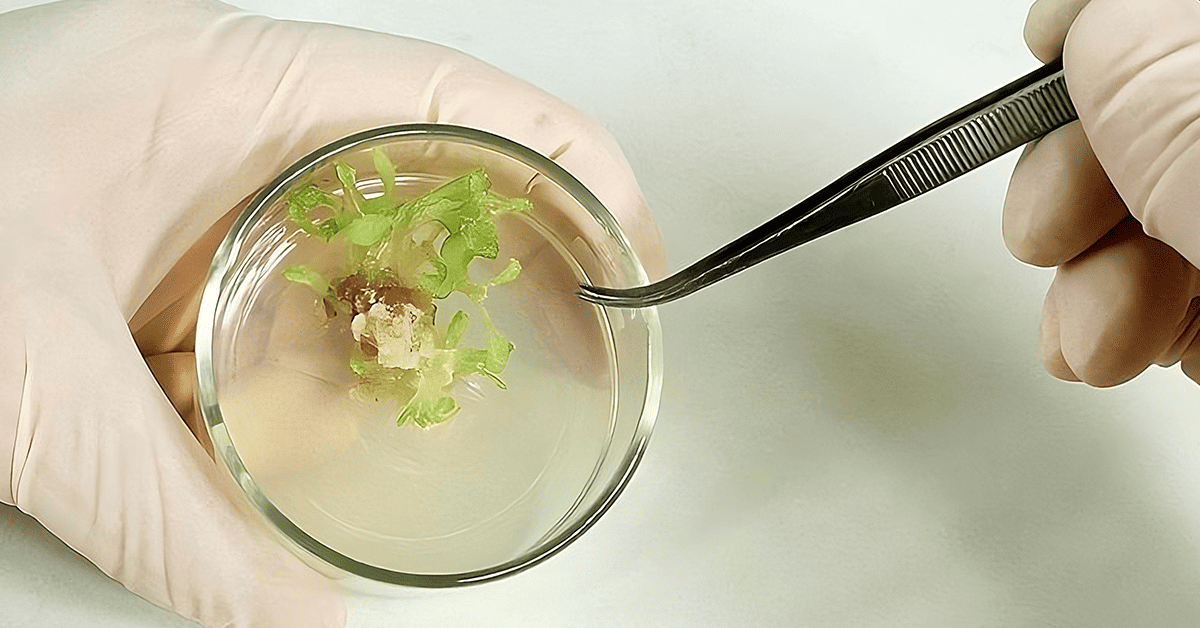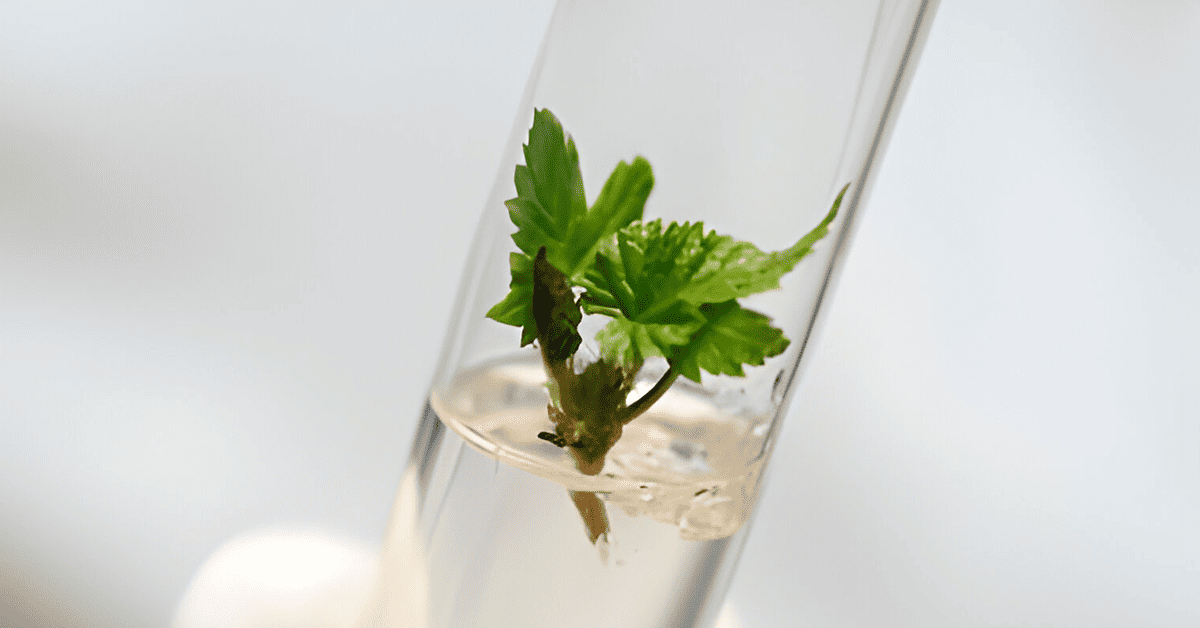
Plant Tissue Culture : A Promising Tool Of Quality Material Production With Special Reference To Micropropagation Of Banana

In the very fast developing scenario of biological science, the plant tissue culture has taken lead as the most
promising areas of application of biotechnological tools for today and tomorrow agriculture. The areas ranges from
micropropagation of horticultural crops, ornamental and forest trees etc., production of pharmaceutically important compounds,
and plant breeding for improved nutritional value of staple crop plants, including trees for cryopreservation of valuable germplasm.
The rapid production of high quality, disease free and uniform planting stock is only possible through micropropagation. Plant
production can be carried out throughout the year irrespective of season and weather. However micropropagation technology is
expensive as compared to conventional methods of propagation by means of seed, cuttings and grafting etc. Therefore, it is
essential to adopt measures to reduce cost of production. Low cost production of plants requires cost effective practices and
optimal use of equipment to reduce the unit cost of plant production. It can be achieved by improving the process efficiency and
better utilization of resources. Use of ‘Bioreactor’ in plant propagation can increase the speed of multiplication and growth of
cultures and reduce space, energy and labor requirements. The cost of production may also be reduced by selecting several
plants that provide the option for around the year production and allow cost flow and optimal use of equipment and resources.
Quality control is also very essential to assure high quality plant production and to obtain confidence of the consumers. The
selection of explant source, diseases free material, authenticity of variety and elimination of somaclonal variants are some of the
most critical parameters for ensuring the quality of the planting materials. The in vitro culture has a unique role in sustainable
and competitive agriculture, forestry and pharmaceutical industry and has been successfully applied in plant breeding for rapid
introduction of improved plants. Plant tissue culture has become an integral part of plant breeding. At present plant cell culture
has made great advances. Possibly the most significant role that plant cell culture has to play in the future will be in its
association with transgenic plants. The ability to accelerate the conventional multiplication rate can be of great benefit to many
crops/countries where a disease or some climatic disaster wipes out crops. The loss of genetic resources is a common story
when germplasm is held in field gene banks. In vitro storage using plant tissue culture tools and cryopreservation are being
proposed as solutions to the problems inherent in field gene banks. By these means the future generations will be able to have
access to genetic resources for simple conventional breeding programmes, or for the more complex genetic transformation
work. As such, plant tissue culture has a great role to play in agricultural development and productivity. In this review,
important steps of plant tissue culture, its critical precautionary points and commercial applications have been discussed.
As Banana is an important food crop and the second most important fruit crop after mango, a special account has been taken into
consideration to also put on record the steps involved in successful micropropagation of it. Despite the significant commercial
value of the banana crop, the main production constraint is the availability of reliable and safe planting material. The planting
materials obtained through conventional methods (suckers) do not meet the increasing demand for planting and they are of poor
quality. Tissue culture is the approach which can solve these problems. Micropropagation of the planting material is also facing
the different challenges which need to be addressed in order to improve its quality production. Some of the problems which
impair the success of the crop include oxidative browning of the wounded tissues and low number of shoots produce per explant.
This review includes the micropropagation studies of commercially important cultivars of banana in the country, highlights the
challenges encountered in its tissue culture and explores the possibilities of optimization of the in vitro propagation techniques
by using explants from shoot tip.

Banana Plantlet Production Through Tissue Cutlure

BANANA PLANTLET PRODUCTION THROUGHTISSUE CULTURE

In vitro multiplication of banana (Musa spp.) cv. Basrai was studied. Shoot tips were cultured on Murashige & Skoog basal medium supplemented with 5.0 mg/l BAP. Observations were recorded at an interval of four weeks for five subculturings. Evaluations were done at each subculture by counting the number of new shoots produced. Shoot tips coming from different rhizomes behaved differently under in vitro conditions. Some being highly productive while others produced less number of shoots. On the average, 124 plants were produced from each shoot tip after five subculturing.

History of plant tissue culture: Trevor A. Thorpe

Abstract Plant tissue culture, or the aseptic culture of cells, tissues, organs, and their components under defined physical and chemical conditions in vitro, is an important tool in both basic and applied studies as well as in com- mercial application. It owes its origin to the ideas of the German scientist, Haberlandt, at the begining of the 20th century. The early studies led to root cultures, embryo cul- tures, and the first true callus/tissue cultures. The period between the 1940s and the 1960s was marked by the devel- opment of new techniques and the improvement of those that were already in use. It was the availability of these tech- niques that led to the application of tissue culture to five broad areas, namely, cell behavior (including cytology, nutrition, metabolism, morphogenesis, embryogenesis, and pathology), plant modification and improvement, pathogen- free plants and germplasm storage, clonal propagation, and product (mainly secondary metabolite) formation, starting in the mid-1960s. The 1990s saw continued expansion in the application of the in vitro technologies to an increasing number of plant species. Cell cultures have remained an important tool in the study of basic areas of plant biology and biochemistry and have assumed major significance in studies in molecular biology and agricultural biotechnology. The historical development of these in vitro technologies and their applications are the focus of this chapter.

Plant tissue culture media and practices: an overview

This review presents an overview of the culture media and practices used in plant tissue culture and developmental biology. The compositions of the most commonly used basal media, especially Murashige and Skoog (MS) and modified MS (MMS), Gamborg’s B5 medium and B5 modifications, Woody Plant Medium (WPM), and Driver and Kuniyuki Woody plant medium (DKW) are discussed, along with typical basal medium manipulations to elicit and support various developmental responses. The most commonly used plant growth regulators and their applications to promote various developmental responses are examined, along with a presentation of the classical phytohormone developmental models for organogenesis and somatic embryogenesis. Elaborated developmental models for both organogenesis and somatic embryogenesis, with emphasis on discrete developmental steps, occasional need for multiple manipulations in culture to achieve a single developmental step, and identification of responsive tissue types in mixed cultures are explored. It is hoped that the information presented here will lead to a deeper understanding of basic tissue culture responses and will assist the reader in the decision-making process by identifying appro- priate media and culture conditions for a particular species or application, or by providing a suitable starting point, should further customization be required.

Dividing and Conquering: A Guide to Propagating Monstera Deliciosa Through Division

The iconic Monstera Deliciosa, also known as the Swiss Cheese Plant, is a beloved houseplant prized for its lush foliage and unique aerial roots. While propagation through stem cuttings is a popular method, division offers an alternative approach to multiply your Monstera and expand your indoor jungle. This guide delves into the intricacies of dividing … Read more

From Tiny Seed to Thriving Plant: Your Guide to Seed Starting

From Tiny Seed to Thriving Plant - Your Guide to Seed Starting

Have you ever dreamt of cultivating a thriving garden from scratch? Seed starting, the art of transforming tiny seeds into flourishing plants, unlocks this magic! This comprehensive guide equips you with the knowledge and essential elements to embark on your seed-starting journey and witness the miracle of life unfold before your eyes.